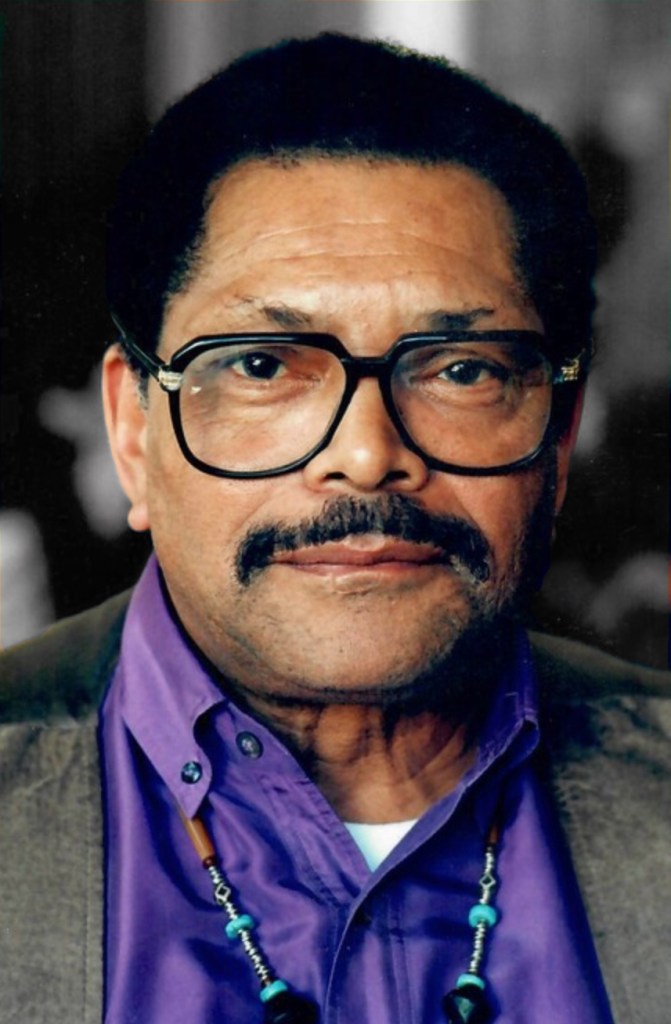
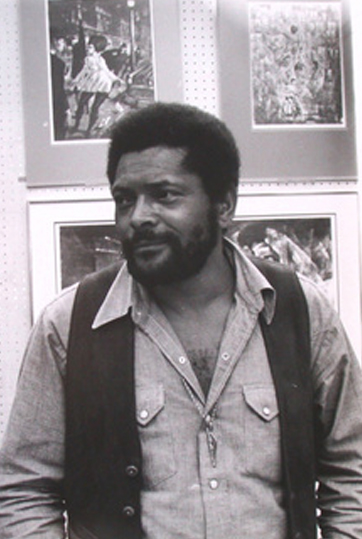
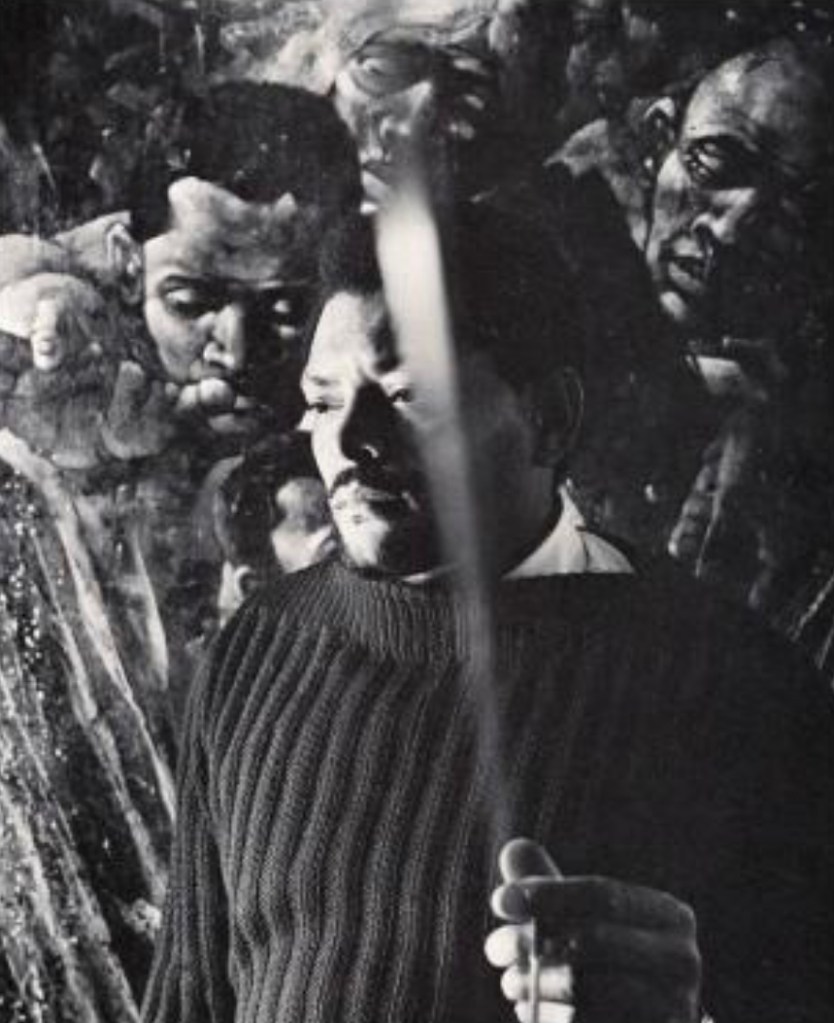
Raymond Howell
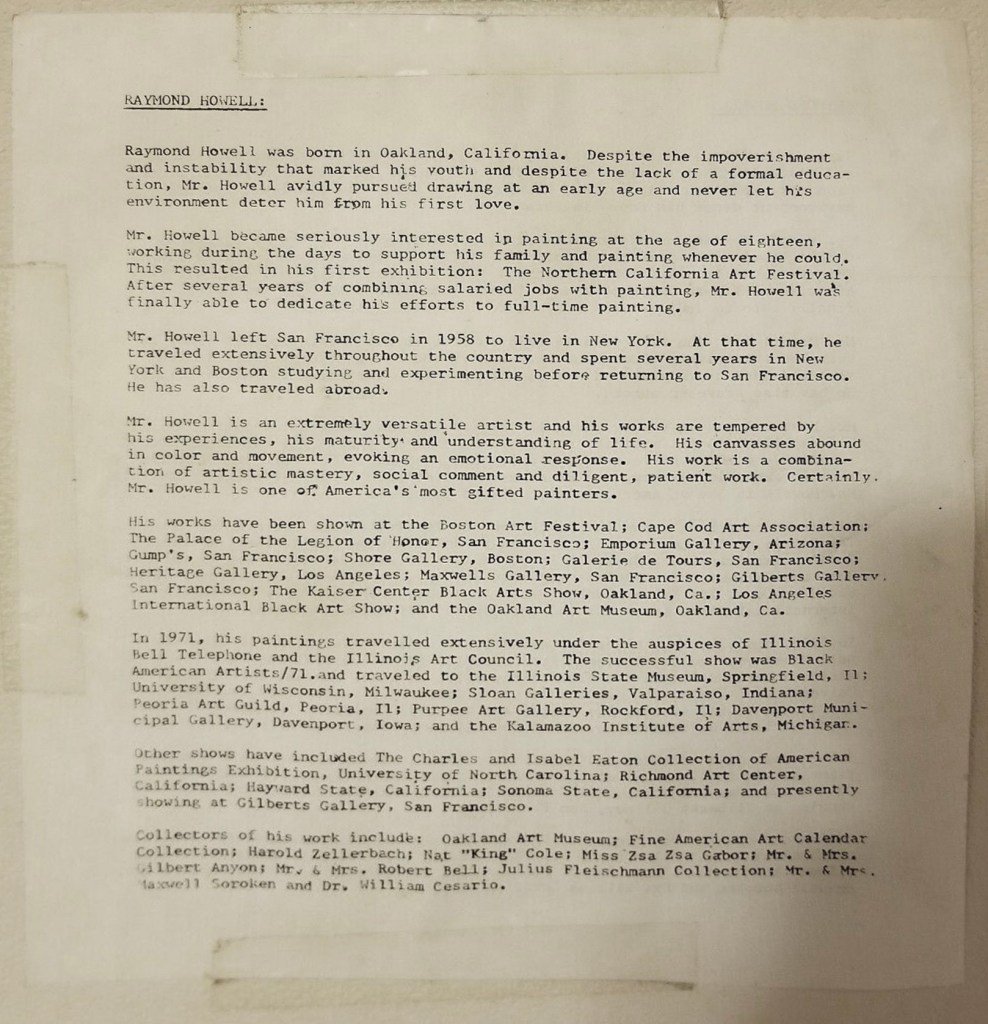
Raymond Howell was born in Oakland, California on September 7, 1927.
An African-American painter and printmaker, Raymond Howell had a difficult childhood environment, growing up in foster homes and with his formal schooling ending by the fifth grade. His interest in art started early … when he was eight he was made to do life-size sketches of his second grade classmates on the blackboard as a punishment for sketching during class. He became seriously interested in painting at the age of eighteen, working during the days to support his family and painting whenever he could.
In 1958 Howell left San Francisco to live in New York City. Over the next few years he traveled throughout the United States, lived in Boston and traveled throughout Europe and Africa, studying, painting, and experimenting with style and technique, before returning to San Francisco in the early 1960’s.
Although Raymond had no formal art training, by the age of thirty he was supporting himself through the sale of his paintings and had started to exhibit his work. Numerous one-man shows were held in San Francisco, Los Angeles, Boston and Provincetown. A solo exhibit titled, “San Francisco Night Life”, took him one year and involved paintings of 24 locations.
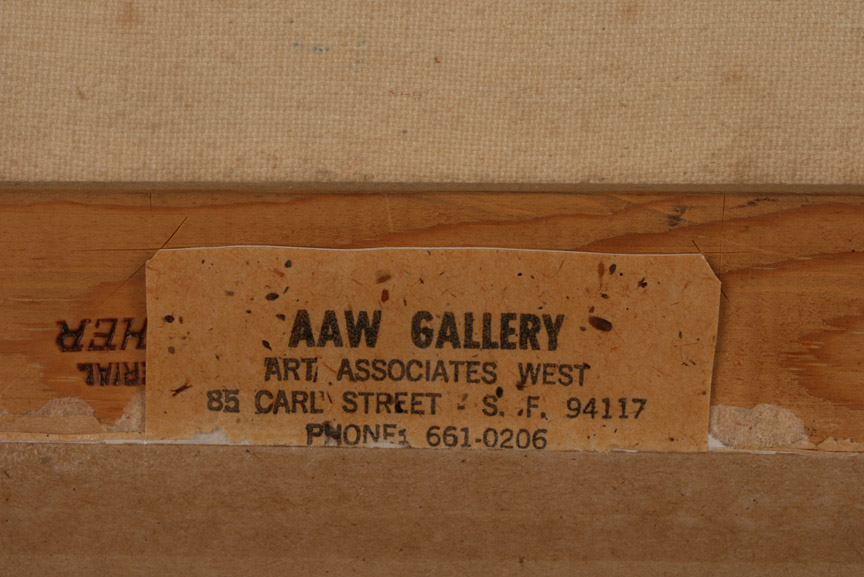
During the mid 1960’s, Raymond Howell opened Art Associates West, located at at 85 Carl Street in San Francisco’s Haight-Ashbury district. It was a combination art gallery – art school where he was both exhibitor and teacher. (He painted a mural on the wall next to the gallery where riders on the N-Judah Streetcar could view it as they traveled to and from downtown San Francisco).
Ray’s 1965 painting “The Brown Family” was shown at the Inaugural Exhibition of the Oakland Museum of California, and was later purchased for the museum collection. His paintings were exhibited widely throughout the United States in solo and group shows during the 1970’s and 1980’s and his large masterwork serigraphs and lithographs were included in International Art Expositions in both New York and San Francisco. Retrospective exhibitions took place at Stanford University in 1999 and at the Oakland Museum in 2002.
Raymond Howell began painting when there was little public interest in African American art. During his lifetime, he served as an inspiration and role model for young artists was committed to promoting arts education opportunities for Black and Hispanic children. He co-founded an art school for poor and minority children in the San Francisco Bay Area under the auspices of Project Dare in the 1980’s.
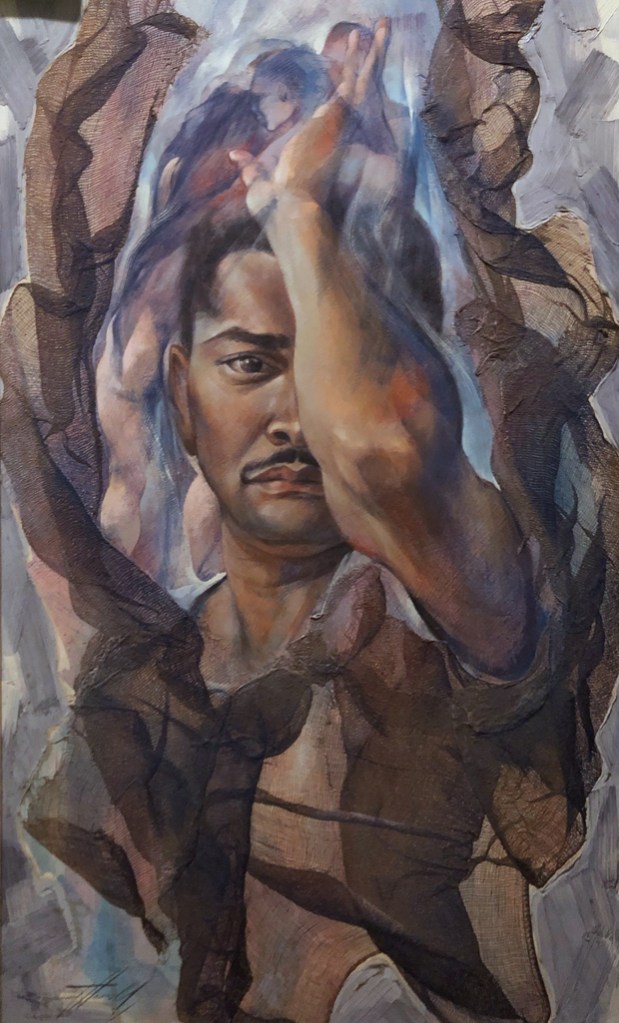
Raymond Howell’s paintings are based in realism, with influences of surrealism, impressionism, and modern abstraction. During the 1990’s he created series of paintings depicting ballet dancers and jazz musicians who were innovators, and he experimented with abstraction and painting combined with collage.
Raymond Howell was an extremely versatile artist and his paintings show many of the techniques used by both the Old Masters (extensive layering of thin pigments for luminosity) and the modernists. His works express his personal experiences and his deep understanding of life.
Raymond Howell died in Oakland, California on January 6, 2002. On that same day an important exhibition of his recent works opened at the Oakland Museum. He was to speak at the event however his death his death had to be announced to a shocked attendance who were looking forward to meeting the artist and listening to him speak about his work.
Many of Howell’s paintings depicted scenes of San Francisco and Oakland, California. In September of 2002 the San Francisco Board of Supervisors declared that September 7th (Raymond’s birthday) would be ‘Raymond Howell Day’ in San Francisco, and in Oakland, January 6th was declared to be ‘Raymond Howell Day’.
“In order to really develop as a painter one must physically explore a direction. My idea was to experiment in painting through African forms. This meant going to Africa, the mother of all development,” – Raymond Howell
“My career began at age eight, when I was required to do life-size images of my second grade classmates on the blackboard, punishment for sketching in class. My formal schooling ended by the fifth grade. After “graduating” from reform school and foster homes, I dedicated myself to art. I am both artistically and academically self-educated.
By the age of thirty I was able to be a full-time self-supporting artist. Numerous one-man shows were held in San Francisco, Los Angeles, Boston and Provincetown. Also, I did a one man exhibit, “San Francisco Night Life”, which took one year of work and involved 24 locations.
A major highlight was participating in the opening of the Oakland Museum. The Brown Painting, in the “Black Perspective” exhibition, was later purchased by the museum for its permanent collection. The following years I opened my own gallery and art school where I developed and perfected a new process which I applied to serigraph printing. I continue to do commissioned portraits.
During the seventies and eighties I exhibited throughout the United States, won many awards, and introduced my original serigraph prints at the International Art Expositions in New York and San Francisco. I participated in foundation, direction and teaching at Project Dare, an art school for minority/poor children in San Francisco.
In 1990 Jeffrey Pollack commissioned me to do an epic mural called the Italian Mural of San Francisco for his New Joe’s Restaurant. The mural is curved 6′ x 43½’, and depicts the history of Italians in San Francisco.
Throughout my career, I have received recognition in publications such as The Christian Science Monitor, Art Forum, Black Artists on Art.” – Raymond Howell
“I was in Africa two years through the auspices of the United Nations. Though I traveled through the West, North and South of Africa, I spent one year in East Africa – Dar es Salaam, Tanganyika (now Tanzania) and Mombasa, Kenya. It was there I became acquainted with Makonde sculpture by touring the museums and art shops. Their work was most impressive. Through the Makonde sculpture different forms and ideas began to take shape in my mind toward a new and positive approach to painting that is related to my own cultural direction and development. The direction is not yet clearly defined, but then is any art form clearly defined or understood in the period in which it is painted?”
– Raymond Howell from: ‘Black Artists on Art’ – 1969 Vol. 1
EXHIBITIONS:
- Maxwell Galleries, San Francisco, CA (first one-man show)
- 1963 – Galerie de Tours, San Francisco. Reviewed in Art Forum Magazine: “Howell has gained in technical skill, but lost his boyish sincerity since those days when he painted San Francisco’s ‘hungry i habitues’ and had his first one-man show at Maxwell’s. He was consistent then. Too many influences are now pulling him too many ways – there are at least three distinct styles, plus their variations, in this one show. The best of them is found in ‘Streets of Tomorrow’ imbued with a sort of West Side Story surrealism.” – Elizabeth M. Polley )
- 1967 – Berkeley Art Festival, Berkeley, California (FirstPrize for Photography)
- 1968 – Berkeley Art Festival, Berkeley, California (First Prize for Photography)
- 1969 – Oakland Museum of California Inaugural Exhibition: Black Perspective Exhibition – “The Brown Family” (purchased by the Museum for it’s permanent collection)
- 1970 – Charles and Isabel Eaton Collection of American Paintings Exhibition, Ackland Art Center, University of North Carolina at Chapel Hill
- 1970 – University of California – ‘ First Superb Black Show ‘ (First Prize)
- 1971 – Oakland Museum of California Oakland Art Museum; ‘ Black American Artists / 71 ‘
- 1971 – Kalamazoo Institute of Arts – ‘ Black American Artists / ’71 ‘
- 1973 – Gilberts Gallery, San Francisco – Raymond Howell, Paintings and Graphics
- 1990 – Mural Commission – ‘ Italian Mural of San Francisco ‘ at New Joe’s Restaurant in San Francisco. 6′ x 43½’ – Depicts the history of Italians in San Francisco.
- 1999 – Stanford University, Palo Alto, CA – Stanford Art Spaces Gallery – 40 Year Retrospective June 18th – August 12th
- 2002 – Oakland Museum of California, Oakland, CA – “Recent Works by Raymond Howell” – Jan. 5th – March 31st (an exhibition of approximately 15 works in oil, mixed media and silkscreen, including street scenes, portraits of jazz musicians and African-American children)
- Heritage Gallery, Los Angeles, CA
- Boston Art Festival, Boston, MA
- Cape Cod Art Association, Barnstable, MA
- The Palace of the Legion of Honor, San Francisco, CA
- Gump’s, San Francisco, CA
- Galerie de Tours, San Francisco
- The Kaiser Center, Oakland, CA
- Los Angeles International Black Art Show
- The Charles & Isabel Eaton Collection of American Paintings
- Richmond Art Center, Richmond, CA
- Hayward State University, Hayward, CA
- Sonoma State University, Rohnert Park, CA
COLLECTIONS:
- Estate of Raymond Howell, New York
- The Melvin Holmes Collection of African American Art : Untitled San Francisco Street Scene – Circa 1978 44″ x 24″ – (page 65 of catalogue: The complete collection of works by African American artists as collected by Melvin Holmes, San Francisco, California.
- Collection of William Parkinson & Kathleen Johannessen, Santa Cruz, California
- The Charles & Isabel Eaton Collection of American Paintings
- Oakland Museum of California, “The Brown Family”
- Fine American Art Calendar Collection
- Harold Zellerbach (1894–1978), San Francisco
- Nat “King” Cole (1919-1965), Santa Monica
- Miss Zsa Zsa Gabor (1917-2016), Los Angeles
- Mural “Italian Mural of San Francisco” – 1990 – 6 ft x 43.5 ft – New Joe’s Restaurant, San Francisco (depicts the history of Italians in San Francisco) – no longer exists
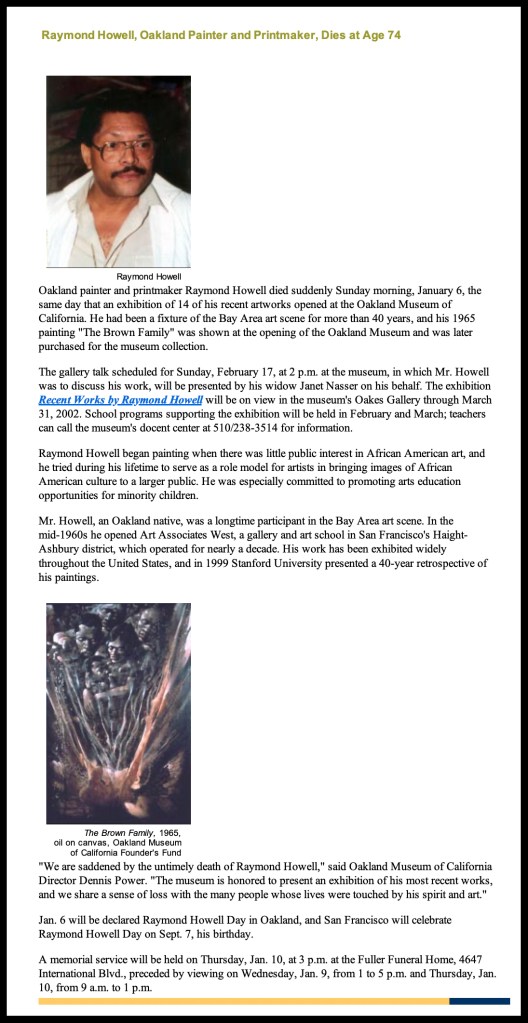
PRESS RELEASE FROM THE OAKLAND MUSEUM
 Raymond Howell ~ American Artist